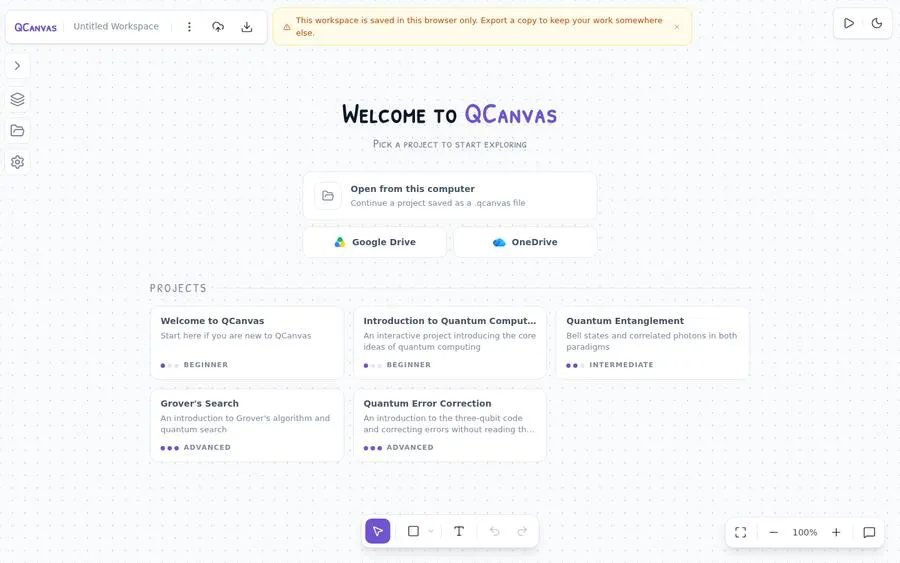
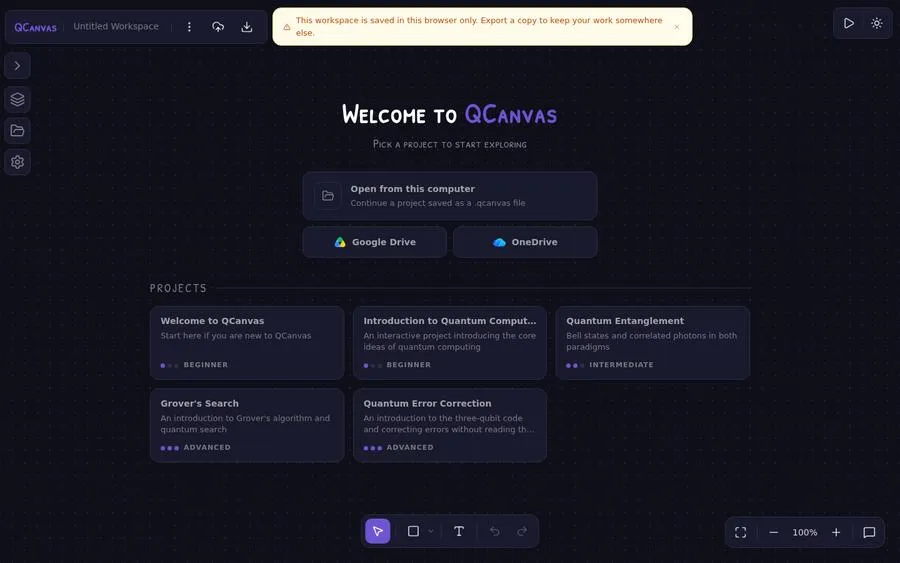
An interactive canvas for quantum education and collaboration

Design, simulate and visualize quantum circuits in your browser, next to the notes, formulas and educational elements that explain them.

Free, No SetupOpen AccessNon-Profit Association

The whole lesson on one canvas

Built for teaching, and for working together. One document you share as a file, hand to a class, or save to Google Drive or OneDrive.

TextMathematicsCircuit designerCircuit examplesSimulationBloch spheresQuizVideo and imagesCode files

Superposition & Measurement

A classical bit is 0 or 1. A qubit can be in a superposition of both:

Measuring gives 0 with probability and 1 with probability . The Hadamard gate H builds an equal superposition from :

So measuring gives 0 or 1 with 50% probability each, a perfect quantum coin flip.

Circuit designer

Definition

  • Hadamard: Turns into an equal superposition of and .

  • Measurement: Reads the qubit as 0 or 1 and writes it to the classical bit.

Simulation results

Bloch sphere

The arrow points at on the equator, halfway between and .

Quiz

1After applying H to , what is the probability of measuring 0?
Show answer

The answer is 50%.

Two H gates in a row

H twice in a row on , then a measurement. Will it be 50/50 again, or something else?

Reveal answer
100% zero. The two H's interfere: the amplitudes cancel and returns with certainty.

Open the full lesson to learn the basics of quantum computing in QCanvas, from superposition to entanglement and whole circuits.

Open this lesson in QCanvas
  1. Start here

    Build, design, simulate

    Drag plugins onto the canvas, resize and move them, and add quiz questions and hint boxes as checks for understanding. Create interactive tutorials, lecture notes or documents.

  2. Multiparadigm

    Qubit and photonic circuits on one canvas

    Design qubit and photonic circuits in one interface, simulate them for free with Qiskit and Piquasso, and compare the two models side by side.

  3. Simulators and quantum computers

    Run on real quantum hardware with qBraid logoqBraid

    Connect your qBraid account, send the same circuit to hosted simulators and real quantum computers, and read the results right next to it.

  4. Exports

    From the canvas to code

    Every format is generated from the circuit on the canvas, so your lesson, your code and your paper show the same circuit.

    OPENQASM 3.0;include "stdgates.inc";bit[3] c;qubit[3] q;h q[0];cx q[0], q[1];cx q[1], q[2];c[0] = measure q[0];c[1] = measure q[1];c[2] = measure q[2];
    • Portable formatsOpenQASM, Quil, QIR, Cirq and pytket for the pipelines you already have.
    • Figures for papersLaTeX with Quantikz, PNG and SVG.

Tutorial

Learn how to use QCanvas, in detail

The full tutorial, recorded in the app, from an empty canvas to a finished lesson.

Watch the QCanvas tutorial on YouTube 10+ min

Built-in projects

Start from a project

Six built-in projects open in the app, from a first tour of the canvas to error correction.

Who it is for

Instructors

Build interactive lessons with explanations, circuits and exercises side by side on one canvas.

Students

Work through lessons at your own pace, simulate circuits and add your own notes.

Researchers

Design circuits, collaborate with colleagues, and export publication-ready figures, LaTeX and SDK code.

Non-profit

Built for teaching

QCanvas is built by QCR MTÜ, a non-profit association in Estonia, and is already used in workshops, universities and high schools.

Free to useOpen accessNon-profit

Teaching with QCanvas, or want to help it grow? Reach out to collaborate on course content, request a feature or support our work.

Cite us in your work

Using QCR or QCanvas in your research or education? Feel free to cite our QCanvas paper.

@inproceedings{Joczik2025QCanvas,
  author    = {Jóczik, Szabolcs and Kecskés, Bence and Kovács, Ádám and Kálmán, Orsolya and Zimborás, Zoltán},
  title     = {QCanvas: An Interactive Browser-Based Quantum Circuit Design and Simulation Platform},
  booktitle = {2025 IEEE International Conference on Quantum Software (QSW)},
  year      = {2025},
  pages     = {137--140},
  doi       = {10.1109/QSW67625.2025.00025}
}

Free, in the browser, nothing to install

Open QCanvas